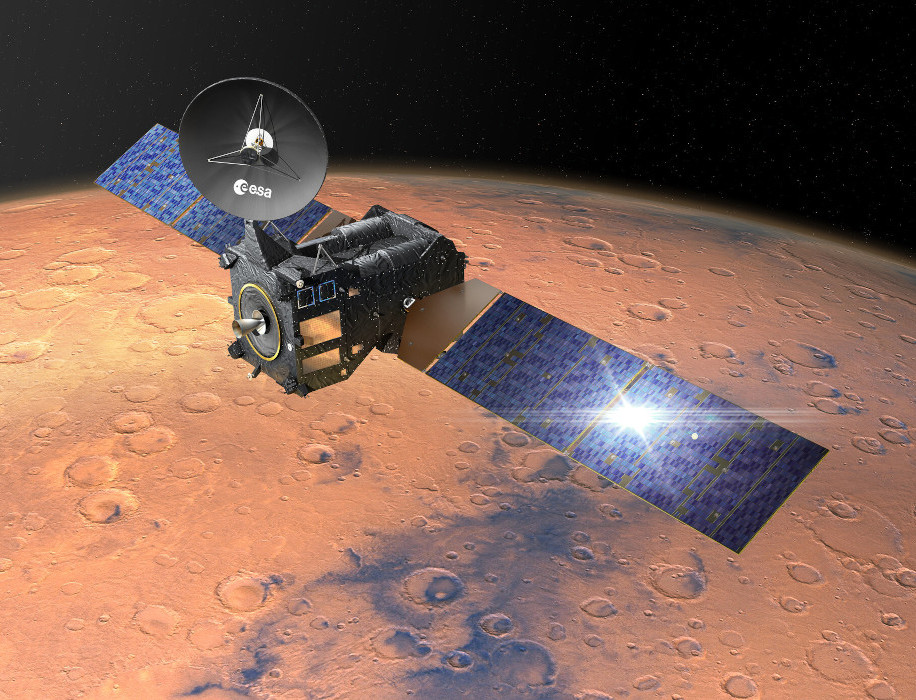
Mission overview
The first mission of the ExoMars programme consists of the Trace Gas Orbiter plus an Entry, descent and landing Demonstrator Module, known as Schiaparelli. The main objectives of this mission are to search for evidence of methane and other trace atmospheric gases that could be signatures of active biological or geological processes and to test key technologies in preparation for ESA’s contribution to subsequent missions to Mars.
The Orbiter and Schiaparelli were launched together on 14 March 2016 on a Proton rocket and flew to Mars in a composite configuration. By taking advantage of the positioning of Earth and Mars the cruise phase could be limited to about 7 months, with the pair arriving at Mars in October.
Orbit
On 19 October, the Trace Gas Orbiter was inserted into an elliptical orbit around Mars. Later, in January 2017, the orbiter performed a number of manoeuvres to shift its angle of travel with respect to the equator to almost 74° from the 7° of its October arrival. This 74° orbit provides optimum coverage of the surface for the science instruments, while still offering good visibility for relaying data from current and future landers. In mid-March 2017, the aerobraking phase began – this eventually brought the orbiter into a circular, approximately 400-km altitude orbit ready to conduct its scientific mission, which started in April 2018.
Science objectives
The Orbiter is used to investigate trace gases with the following scientific objectives:
- Deliver a detailed characterisation of the Martian atmosphere’s composition – This includes mapping the distribution of trace gases, identifying their sources and sinks, and studying geographical and temporal variability. The first scientific goal will be to detect a broad suite of atmospheric trace gases, and key isotopologues (molecules that have at least one atom with a different number of neutrons than the parent molecules), to establish the atmospheric inventory. Following a positive detection of key species, geographical (location and altitude) and seasonal mapping will be carried out. Mapping of the deuterium/hydrogen ratio (D/H) will also be performed, to provide new information on water reservoirs and atmospheric escape. A third goal is characterising the state of the atmosphere, in particular temperatures, aerosols, water vapour, and ozone. The data assimilation technique adopted by the science team will allow them to model the atmospheric circulation. This will help determine whether particular gases are emanating from specific areas on Mars and to provide insights into the nature of the trace gas source.
- Imaging of surface features – Another important objective is to image and to characterise features on the Martian surface which may be related to trace gas sources. The data should provide information on the geological and dynamical context (such as volcanism) for any sources detected.
- Mapping of subsurface hydrogen – The final objective is to map the subsurface hydrogen to a depth of one metre, with a resolution ten times better than previous measurements.
Payloads
The Trace Gas Orbiter carries scientific instruments for the detection of trace gases with an improved accuracy – 1000 times better – compared to previous measurements from orbit and ground-based measurements. It is also providing new data for the study of the temporal and spatial evolution of trace gases in the Martian atmosphere, and for the location of their source regions. The Trace Gas Orbiter carries a science payload of the following four instruments:
- NOMAD – Nadir and Occultation for MArs Discovery. NOMAD combines three spectrometers, two infrared and one ultraviolet, to perform high-sensitivity orbital identification of atmospheric components, including methane and many other species, via both solar occultation and direct reflected-light nadir observations.
- ACS – Atmospheric Chemistry Suite. This suite of three infrared instruments will help scientists to investigate the chemistry and structure of the Martian atmosphere. ACS complements NOMAD by extending the coverage at infrared wavelengths, and by taking images of the Sun to better analyse the solar occultation data.
- CaSSIS – Colour and Stereo Surface Imaging System. A high-resolution camera (5 metres per pixel) capable of obtaining colour and stereo images over a wide swathe. CaSSIS provides the geological and dynamical context for sources or sinks of trace gases detected by NOMAD and ACS.
- FREND – Fine Resolution Epithermal Neutron Detector. This neutron detector can map hydrogen on the surface down to a metre deep, revealing deposits of water-ice near the surface. FREND’s mapping of shallow subsurface water ice will be up to 10 times better than existing measurements.

Science Highlights

Credit: ESA; spacecraft; ESA/ATG medialab