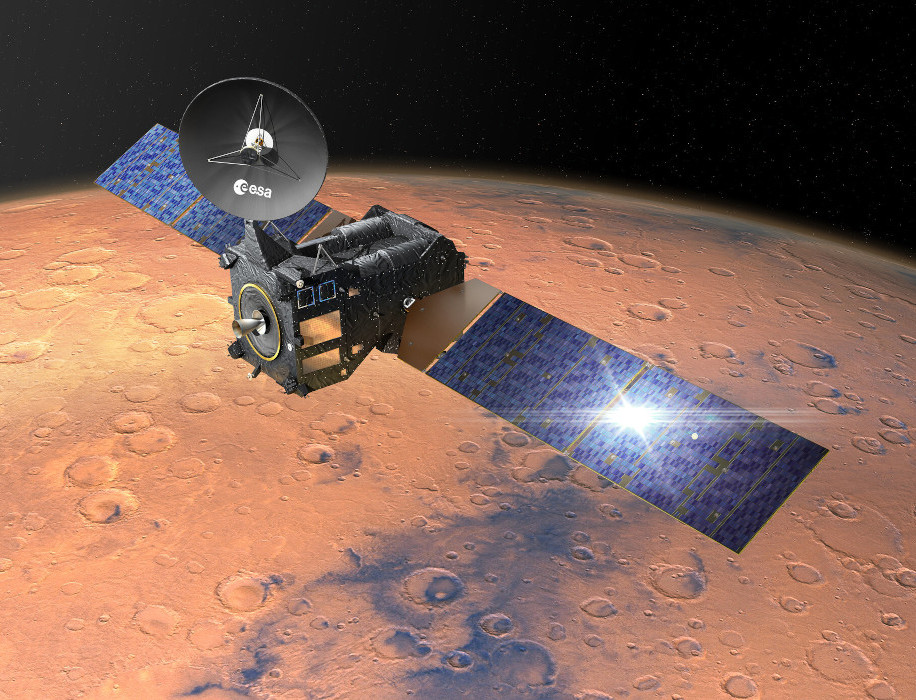
The European Space Agency (ESA) has selected a new cohort of scientists to contribute to the scientific exploitation of the ExoMars Trace Gas Orbiter (TGO), reinforcing the mission’s role as a key asset for Mars exploration and international scientific collaboration.
Following the Announcement of Opportunity issued earlier this year, ESA has appointed three Interdisciplinary Scientists and seven Guest Investigators. The selected researchers will contribute new investigations and perspectives that support the scientific objectives of TGO, the broader ExoMars programme, and ESA’s Explore 2040 strategy.
Interdisciplinary Scientists
Three scientists have been appointed as Interdisciplinary Scientists, reflecting the growing importance of cross-disciplinary investigations in Mars exploration.
Juan Alday
Instituto de Astrofísica de Andalucía, Spain
Juan Alday will coordinate observation campaigns involving ground-based telescopes in conjunction with TGO measurements. These complementary observations provide different sensitivities and spatial coverage for key atmospheric trace gases, helping scientists build a more complete picture of Martian atmospheric chemistry and its variability.
James Holmes
The Open University, United Kingdom
James Holmes will lead a global atmospheric modelling activity that combines observations from TGO and other Mars orbiters. By assimilating multiple datasets into a four-dimensional reconstruction of the Martian atmosphere, the project will improve the interpretation of trace-gas measurements while contributing to the development of future weather forecasting capabilities for Mars exploration.
Daniel Mège
Polish Academy of Sciences, Poland
Daniel Mège will investigate trace gases that may be linked to present-day magmatic activity on Mars. Building on ongoing studies of hydrogen chloride, his work will combine observations from all four TGO instruments, using atmospheric measurements as indicators of potential geophysical processes occurring beneath the planet’s surface.
Guest Investigators
Seven Guest Investigators have been selected to pursue a diverse range of investigations using TGO observations.
Valentin Bickel
University of Bern, Switzerland
Valentin Bickel will analyse CaSSIS imagery to identify and track dust devils across the Martian surface. By measuring their movement, the study will provide new insights into near-surface winds and the processes that lift dust into the atmosphere.
Benjamin Bultel
Université Paris-Saclay, France
Benjamin Bultel will use the multispectral imaging capabilities of CaSSIS to investigate weathering processes and the geological signatures of water-related and volcanic activity on Mars.
Colin Dundas
United States Geological Survey, United States
Colin Dundas will study the formation and evolution of Martian gullies through the combined analysis of imagery from TGO’s CaSSIS camera and NASA’s HiRISE instrument aboard the Mars Reconnaissance Orbiter.
Antonio Genova
Sapienza University of Rome, Italy
Antonio Genova will conduct a range of radio science investigations, including gravity-field mapping and geodetic studies. These measurements will improve understanding of the Red Planet’s interior structure and ongoing geological evolution.
Fabrizio Oliva
Istituto Nazionale di Astrofisica, Italy
Fabrizio Oliva will investigate the distribution and properties of Martian dust and aerosols by combining observations from TGO’s NOMAD instrument with data collected by Mars Express’ OMEGA spectrometer.
Martin Pätzold
Rheinisches Institut für Umweltforschung, Germany
Martin Pätzold will employ TGO-to-Earth radio occultation experiments to derive atmospheric temperature and pressure profiles. These measurements will support studies of the thermal structure of the atmosphere as well as atmospheric waves and tides.
Paul Withers
Boston University, United States
Paul Withers will use radio occultation observations to characterise Mars’ ionosphere and examine how it responds to changing conditions in the solar wind, improving understanding of interactions between the Martian atmosphere and space environment.
Looking ahead
The appointments come at a significant moment for the mission. On 19 October 2026, ExoMars Trace Gas Orbiter marked ten years since entering orbit around Mars.
Over the past decade, TGO has transformed our understanding of the Martian atmosphere and delivered high-resolution observations of the planet’s surface.
As the mission enters its second decade of operations, the newly appointed Interdisciplinary Scientists and Guest Investigators will help ensure that TGO continues to deliver innovative science and support future exploration of the Red Planet.
Image Credit: ESA/ATG MediaLab